
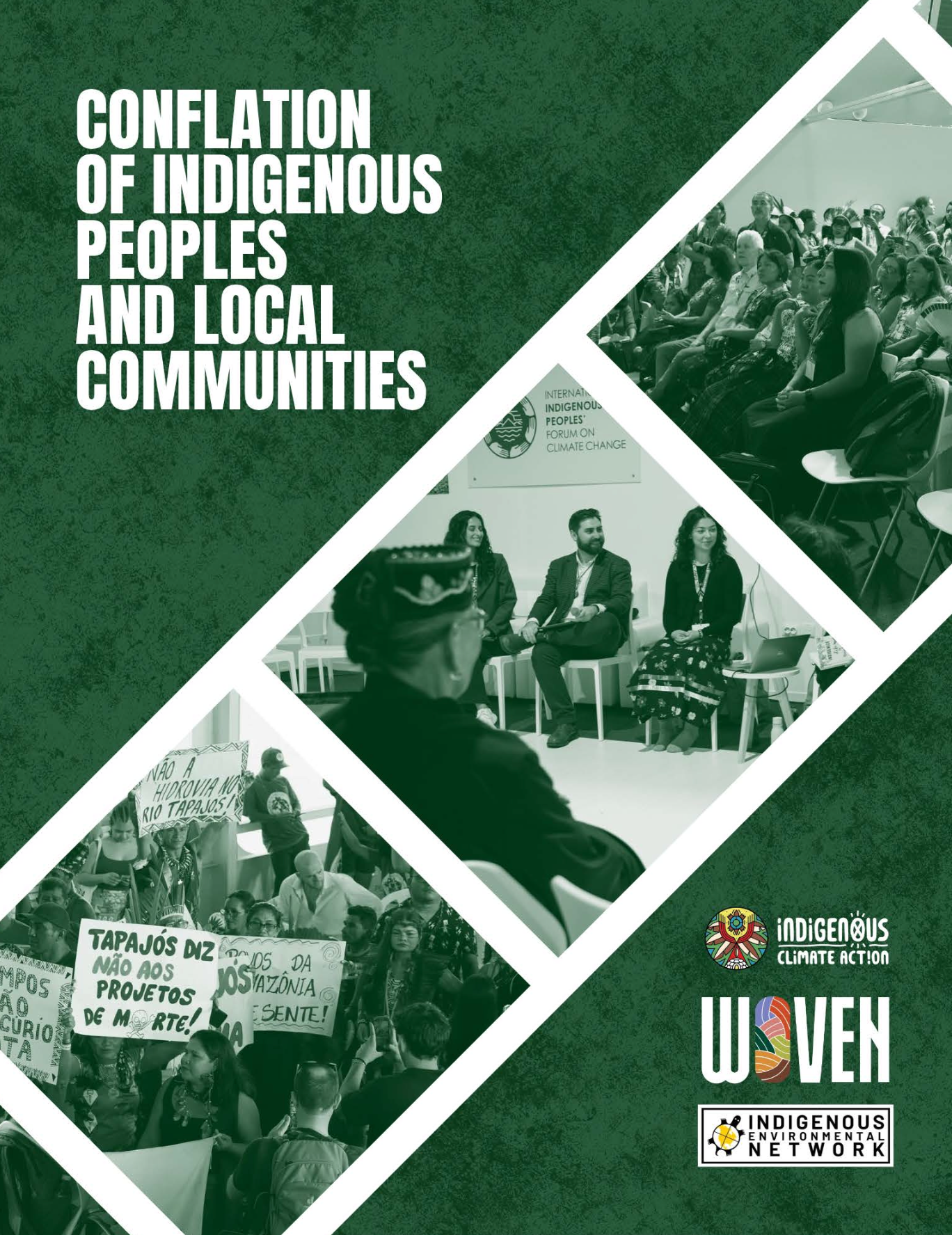
Conflation of Indigenous Peoples and Local Communities
Indigenous Peoples did not fight for generations to be branded as stakeholders. The routine conflation of “Indigenous Peoples and local communities” in climate and environmental policy risks doing exactly that.
Unlike Indigenous Peoples, “local communities” have neither a universally agreed definition nor a distinct, internationally recognized framework of collective rights. The term can include groups whose interests conflict with Indigenous rights and title. Treating the two as interchangeable blurs whose authority must be respected and whose consent must be sought. It also harms local communities by obscuring their particular needs and priorities, making it easier for institutions to claim inclusion without establishing meaningful processes for their participation.
Indigenous Peoples and local communities can stand together against extractive industries, environmental destruction and climate injustice. Strong alliances make room for differences in rights, responsibilities and authority, including when interests diverge. Solidarity requires relationships built through trust, accountability and respect for self-determination.
Institutions must stop treating blurred distinctions as evidence of progress. If inclusion requires Indigenous Peoples to surrender our distinct status and rights, whose interests does it serve?
Learn more by reading our report launched in partnership with ICA and the Indigenous Environmental Network (IEN) during COP31.
Conflation of Indigenous Peoples and Local Communities, November 2026
ICA x Woven COP31 Delegation Positions
We must be clear - Indigenous Peoples’ attendance is NOT consent.
While ICA and Woven engage in colonial international spaces like the United Nations Framework Convention on Climate Change (UNFCCC), this is not to embrace the very systems that continue to oppress us. Rather, it is a means to advocate for Indigenous communities and assert our rights in spaces where decisions are being made about the future of our lands and waters along with the potential multi-generational impacts on Indigenous peoples.
Our goal is not to seek validation of our knowledge and ways of being, but to center Indigenous ways of knowing and sovereignty in these global climate discussions without compromise. When colonial leaders gather at an international level to negotiate decisions that affect our lands, rights and culture—Indigenous peoples must be given a voice.
This year, at the UNFCCC COP31, we are focusing on the following areas:
Loss & Damage
Just Transition
No False Solutions
Solidarity with the Global South
Sovereignty as the Solution
Conflation of Indigenous Peoples & Local Communities
Learn more by reading our UNFCCC COP31 Position Paper.

Mapping Indigenous Peoples in United Nations Environmental Process
This report offers the first comprehensive mapping of the participation of Indigenous Peoples across global environmental movements, taking a specific look at United Nations’ policy and scientific processes related to climate change, biodiversity, desertification, and the environment. It deepens these findings with insights from an in-person Indigenous Gathering in Aotearoa/New Zealand and in-depth interviews with Indigenous leaders. Using this information, it proposes targeted recommendations to strengthen the participation and presence of Indigenous Peoples within global environmental movements.