Reflections on the Transition Away From Fossil Fuel Conference
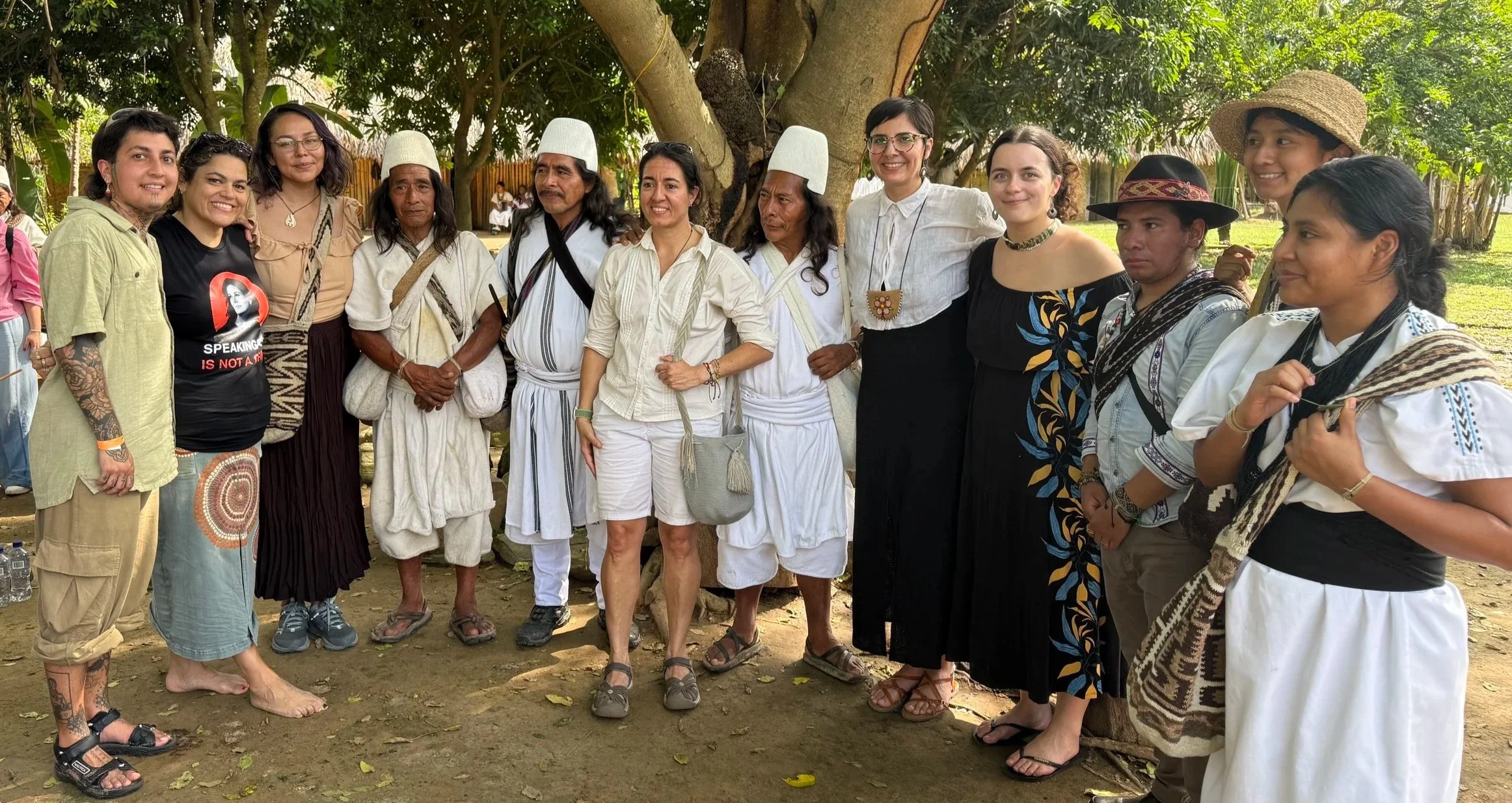
This past month (April 2026), the Woven Project team, along with members of Global Indigenous Advisory Council, attended the First International Conference on the Transitioning Away from Fossil Fuels (TAFF), the People’s Summit and Indigenous Peoples Pre-assembly in Santa Marta, Colombia. Woven prioritized our time and efforts in support of the autonomous Indigenous Peoples space hosted by OPIAC - who spent months negotiating with the Colombian government to support Indigenous Peoples and voices.
What was the TAFF?
The TAFF conference was hosted by the Colombia and Netherlands governments, and was the first of its kind, branded as a space outside of the UN where they could “initiate a concrete process through which a coalition of committed countries, subnational governments, and relevant stakeholders can identify and advance enabling pathways to implement a progressive transition away from fossil fuels, creating sustainable societies and economies.” The conference was open to countries, subnational governments, academia, Indigenous Peoples, Peoples of African Descent, peasants, civil society, workers, the private sector, and other key actors at different stages of the transition.
Over 50 nation-states attended this inaugural gathering. Absent were many of the major oil-producing states, but Canada and Australia both attended. States in attendance according the websiteAngola, Australia, Austria, Bangladesh, Belgium, Brazil, Cambodia, Cameroon, Canada, Chile, Costa Rica, Denmark, Dominican Republic, European Union, Fiji, Finland, France, Germany, Ghana, Guatemala, Iceland, Ireland, Italy, Jamaica, Kiribati, Luxembourg, Maldives, Marshall Islands, Mauritius, Mexico, Mongolia, Netherlands, Nigeria, Norway, Palau, Panama, Papua New Guinea, Philippines, Portugal, Senegal, Singapore, Slovenia, Spain, Sri Lanka, Sweden, Switzerland, Trinidad and Tobago, Türkiye, Tuvalu, United Kingdom of Great Britain and Northern Ireland, United Republic of Tanzania, Uruguay, Vanuatu, Vietnam.
Elements of this conference were in response to a global effort to develop a Fossil Fuel Non-Poliferation Treaty, something that is greatly needed. However, the process for this treaty still relies heavily on upholding colonial systems and processes. This conference was built in that frame and the three thematic areas to guide the conversations at the conference were as follows:
Overcoming economic dependence
Transforming supply and demand
Advancing international cooperation and climate diplomacy
As an Indigenous participant I found there were severe limitations to these categories and it was clear the framing was very reductionist centering existing capitalist economies over planetary health and human rights. Historically, discussions on fossil fuels and a just transition have not been welcomed in the UN spaces as major oil producing countries and corporations dominate discussion trying to maintain the status quo of petrostate economies and “solutions” that don’t threaten them. This conference proposed to work outside of the UN systems and spaces that would allow for more robust conversations with various stakeholders, and conversations that have remained stagnant for decades.
While many people applauded brave states, like Colombia, in building a space to have “difficult” conversations and share ideas, plans and strategies for transitioning away from fossil fuels, I personally felt it fell short of achieving anything transformational or ambitious. While I appreciated the intent of creating a new and improved space, I struggled with how this “new space” didn’t function any differently than standard UN negotiations spaces, and still treated Indigenous Peoples as “stakeholders” with the same, in perhaps even diminished, access to high level discussion along with the rest of civil society. It was even more surprising to see major oil producing nations like Canada and Australia present considering they have been doing very little to transition away from fossil fuels, have a deep history of exclusionary and racist policies for Indigenous Peoples, and in many respects are doubling down on production and using false solutions and net zero strategies to cover their tracks.
I don’t know how to stress this enough, Indigenous Peoples have unique regional, national and internationally recognized inherent and distinct collective rights over our lands, territories and waters. The UN Declaration on the Rights of Indigenous Peoples (UNDRIP) (2007) established a universal framework for the MINIMUM (not maximum) standards for the dignity and well-being of Indigenous Peoples. It holds up our rights to self-determination, access and decision making to our lands, territories and culture. Most notable are the multiple references to Free, Prior and Informed Consent (FPIC) throughout the Declaration. This is important in the context of this conference and the themes discussed throughout, each area interconnected to the other, and proposed solutions often in contravention to upholding the rights of our Peoples.
At the TAFF, colonial states continued to control the space, how it would function, who would have access to what and where and why, ultimately sidelining and siloing civil society and Indigenous Peoples alike. This was a direct abrogation of the tenets of UNDRIP and FPIC and it is clear that states are still grappling with what it means to truly uphold UNDRIP and respect our rights to self-determination. For Indigenous Peoples, our knowledge, sciences and ways of being are interwoven into the fabric of our cosmology and into the ways we see solutions to the climate crisis, which is a poly crisis. We can no longer silo transitioning away from fossil fuels from a just transition, human rights, Indigenous rights and the protection and preservation of all life. Something that felt difficult in a space that was designed to divide us into segments and issues to be worked through separately.
Ultimately, this led to high tensions between Indigenous Peoples, civil society organizations (CSOs), national governments, sub-nationals, and global NGO’s. What unfolded was significant efforts by all the various stakeholders to control the narrative of this so-called transition. For Indigenous Peoples this meant stretching ourselves across the different sectoral spaces, trying to ensure that our rights, our ideology and way of life remained present and relevant.
The biggest challenges for Indigenous Peoples that we witnessed were as follows:
Exclusion of Indigenous Voice: Indigenous peoples were frequently excluded from the broader CSO spaces and official People’s Assemblies and only had limited access to the high-level segments.
Competing Agendas: Direct conflicts arose between government-led transition plans and the localized, rights-based demands of frontline communities.
Scheduling Overlaps: The People’s Assemblies on April 26th and 27th intentionally or unintentionally overlapped with the Indigenous Peoples Autonomous Meeting, forcing a fragmentation of Indigenous representation.
The Outcomes
It should be noted that nothing was binding, everything felt a little performative, ethereal and unclear how this conference would actually move the needle on transitions away from fossil fuels. It felt like a lot of hot air, comparable with the scoring heat of Santa Marta. I found one of the most jarring hypocrisies of the conferences was how everything was being powered by diesel generators in an attempt to not overload the grid when keeping conference attendees cool inside the venues.
Moreover, it was even more unclear how states would actually include, value and uphold Indigenous Peoples rights, voices and ways of being, in building a true transition away from fossil fuels. This was especially true when we learned that the high-level segments would be limited and there would be little to no room for broader Indigenous participation in the actual dialogues with states. They would relegate the thousands of participants (civil society, including Indigenous Peoples) who travelled to Santa Marta to, in some cases, literally fight for one of the limited “observer” tickets to enter the high-level space. If you were lucky enough, you might even have been granted the even more limited “speaker” ticket so that you would be allowed to speak with accredited delegates.
I would be remiss to not mention that the hosts of the conference relied heavily on AI to synthesize session discussions and written submissions. While this meant that the final outcomes of the conference were released on April 30th, it meant turning away from the energy and water intensity of AI, not to mention the human and Indigenous rights implications associated with it. I also couldn’t help but wonder how much was excluded and what kinds of AI hallucinations there may have been.
Throughout the 15 page outcome document Indigenous Peoples are only mentioned 4 times, and there are no references to the Position paper that global Indigenous peoples spent weeks drafting and days negotiating the finality of. Additionally, there were no references to the direct relationship between wars and conflict and fossil fuels, the ongoing pursuit of false solutions, geoengineering, and nuclear energy as ways to achieve net zero without actually transitioning away from fossil fuels. In fact, during the high-level segments, many nation-states named carbon markets, biodiversity offsets and other false solutions as necessary to build a pathway to transition away from fossil fuels.
States in the high-level segment really shone a light on how states see a transition away from fossil fuels “requires” carbon markets and other false solutions that can "stabilize" regional economies. Additionally, we heard the same old, same old focus on stabilizing capitalist economies by limiting the discussion to energy transition, carbon accounting and how states can maintain power and control over resources and their positions of power at the global stage. This leaves Indigenous Peoples and those most impacted completely out of the equation and left on the sidelines.
For Indigenous Peoples, a real transition will require a holistic approach that isn’t just about fossil fuels and must include discourse on the increasing use of false solutions such as carbon markets, geoengineering, nuclear and biodiversity offset, and global strategies to mine critical minerals deemed necessary for an energy transition. While the space was fragmented and disorganized, and sometimes a bit challenging to navigate, it was a necessary space to participate in to ensure that our voices, issues and rights were not invisibilized again. So we showed up, everywhere we could and even if we weren’t meaningfully included in the outcomes, we were there demanding a better way forward.
The Indigenous Peoples Voice and Space
“Indigenous Peoples are rights-holders, self-governing Peoples, and guardians of our territories and Mother Earth. Without the right to self-determination, Free, Prior and Informed Consent, and the legal protection and security of our territories, lands and waters, there is no climate, environmental and economic justice. The Just Transition recognizes that humans are inseparable from Earth and nature. The Just Transition and phase out of fossil fuels must be built with us or it will not be just.”
The final position paper developed by Indigenous peoples was a beautiful articulation of what a real pathway to transitioning away from fossil fuels can look like. We developed 13 principles that guided our responses to the three thematic areas of discussion, providing clear and articulate strategies to address each area while upholding the rights, culture and lives of Indigenous peoples. The final position paper can be found here.
One of the most important articulations in the position paper was the Elimination and non-repetition of extractivism, Reject climate false solutions, and Move away from market mechanisms and financialization of Nature, and the acknowledgement of existing global agreements adopted by all nation-states in the UAE Just Transition Work Programme, paragraph 12.i, which states:
“...i) “The importance of the rights of Indigenous Peoples including their right to free, prior and informed consent and the importance of ensuring that all just transition pathways respect, protect and promote the distinct, collective and internationally recognized rights of Indigenous Peoples, including the right to self-determination, and acknowledge the specific rights and protections for Indigenous Peoples in Voluntary Isolation and Initial Contact, in accordance with relevant international human rights instruments and principles;”
For the Woven team we prioritized this space and supported the work to secure and defend an autonomous Indigenous-only spaces where knowledge, strategy, and innovation could be exchanged without the interference of colonial timelines or state-driven agendas. This space was coordinated by OPIAC with support from the Colombian government. OPIAC did a tremendous job of setting up coordination calls in the lead up to the conference and hosting two days of meetings to refine and define a statement of Indigenous Peoples for a transition away from fossil fuels.
This allowed us to participate in the following:
Shifting the Narrative: Moving the discourse away from Western-centric “solutions” toward Indigenous-led solutions rooted in Indigenous Knowledges and Sciences, Inherent and Collective Rights, Land Back and Upholding the UN Declaration on the Rights of Indigenous Peoples.
Uplifting Global Solidarity: Strengthening relationships with regional and global partners to ensure Indigenous voices directly inform global policy.
Contributing to Indigenous Peoples Statement: Participating in the development of the Indigenous Peoples Statement that highlights the leadership, needs and demands of Indigenous Peoples in developing pathways for transitioning away from fossil fuels and building a true just transition.
This engagement served as a critical platform to advance Woven's mission of bridging ancestral knowledge with modern climate action while ensuring Indigenous self-determination remains at the forefront of the global energy transition.
However, it was very challenging to decide which spaces we would participate in as the civil society coordinated Peoples Assembly, which overlapped with the Indigenous Peoples pre-assemblies. We found ourselves trying to decide who would go where and what positions we would hold in each space. Additionally, there was very limited participation of Indigenous peoples beyond Latin America, with only a small handful of representatives from other regions.
Ultimately, the statement created by global Indigenous representatives present at the conference was a strong articulation of our needs and demands in the pathway for transitioning away from fossil fuels and beyond. We strived for a consensus model in working out language, identifying key issues and proposing solutions to the three themes proposed by the conference host. The group went beyond and laid foundations to address how conflict, the pursuit of critical minerals and false solutions continue to be sidelined in the conversations and why our people, our knowledge, our way of being, and our rights to self-determination are essential.
It’s clear we have a lot of work to do, and it remains unclear how the position paper we worked on will be used, referenced or considered by colonial states.
Conclusion
The tensions witnessed in Colombia underscore the primary threat to climate solutions: the continued colonization of the transition process, which extracts resources from Indigenous lands while excluding their stewards from decision-making. We were left with a watered-down, weakened outcome document that continues to perpetuate the status quo of colonial capitalism as the beating heart of society, driving business as usual in extractive industries, and dividing the global majority movements by making us fight for scraps and a perverted semblance of power. I would have liked to have seen a better reflection of how this would lead to the fossil fuel treaty and include key stakeholders in the process, but that felt unclear and even omitted from the final outcomes.
I want to underscore and acknowledge that this was an experimental conference and brought an important conversation to the forefront of colonial nation-states. A conversation that Indigenous Peoples and those most deeply impacted by the fossil fuel industry have been asking for. So while this conference may not have had the conclusion we may have hoped for, we are very curious how the next proposed iteration of this conference in Tuvalu in 2027 will amend mistakes made at this one.
One final reflection happened during the closing plenary when the Minister of Tuvalu announced they would be the host of the next TAFF he also made a powerful remark stating that Indigenous peoples will be a central player in leading discussions. To my surprise, the statement gave way to almost no fanfare or applause. I felt like I was a lone voice cheering in the audience. This was juxtaposed when the minister went on to share how civil society actors would be more deeply engaged and included, and the room burst into claps and hollering - a real demonstration that there is still a long way to go in understanding the value of Indigenous rights, culture, knowledge and sciences in these spaces.
Following this conference, Woven is continuing to prepare for our inaugural global gathering in September 2026 to further consolidate an autonomous global Indigenous space to share our strategies, knowledge, culture and voice to build a cohesive movement of Indigenous climate leaders. We remain dedicated to the prophecy that survival depends on the shared strength and knowledge of all Indigenous Peoples from every corner of the world. We have a lot of work to do to demonstrate the power and scale of Indigenous Peoples in advancing climate solutions and strategies that the whole world could benefit from.